
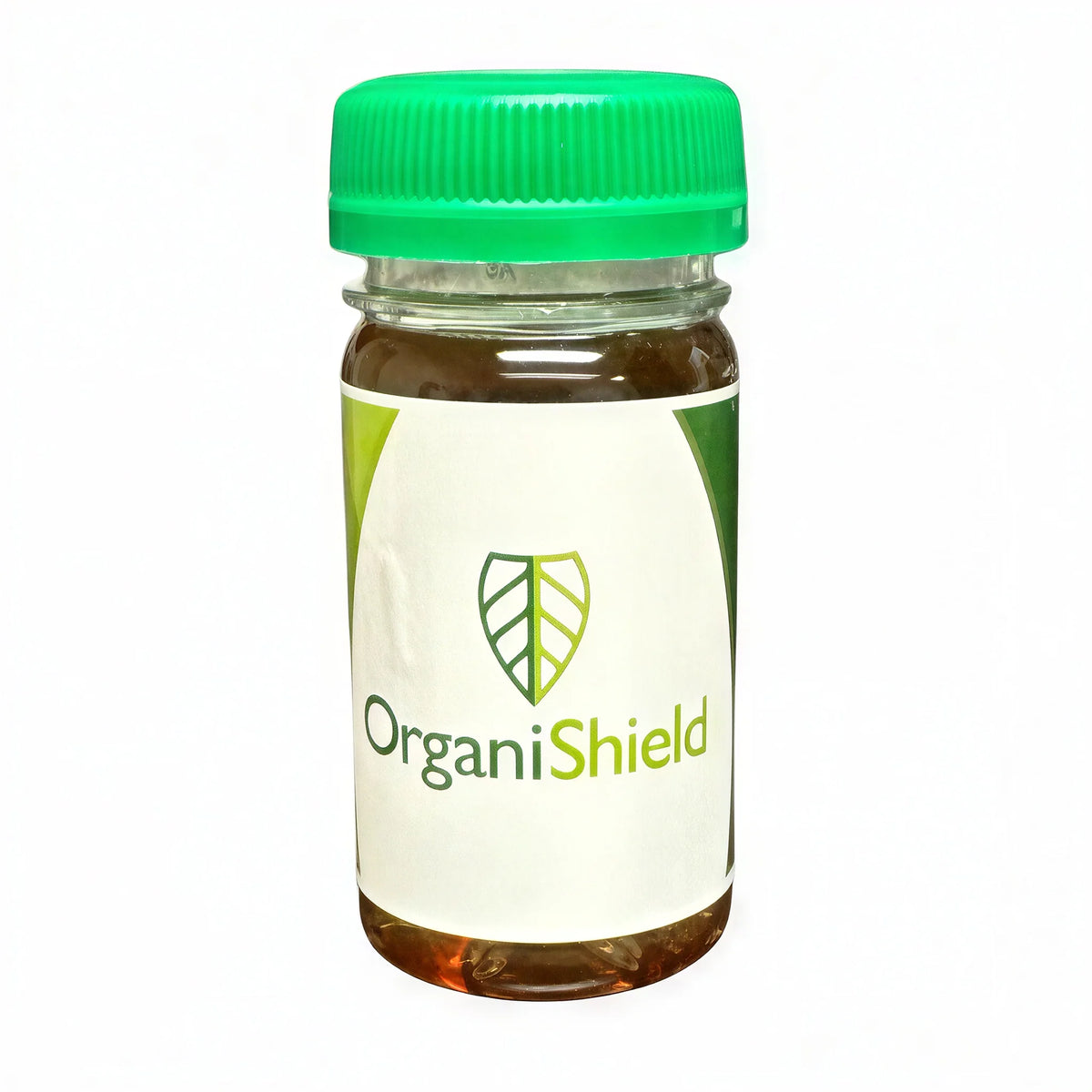
EPA-registered sucrose octanoate biopesticide — contact kill, zero-day PHI, no oils.
OrganiShield is an OMRI-listed, EPA-registered biochemical insecticide and miticide built around Sucrose Octanoate Esters (SOE) — a contact-kill molecule derived from plant trichomes that dissolves the waxy cuticle of soft-bodied pests within minutes to hours. No oils, no synthetic residues, and a 0-Day Pre-Harvest Interval make it compatible with licensed cannabis and hemp production schedules from veg through final days of flower.
OrganiShield (formerly marketed as Sucrashield) is a biochemical biopesticide registered with the EPA and listed by OMRI for organic use. Its active ingredient — Sucrose Octanoate Ester (SOE) at 40% concentration — is a sugar ester that certain plants produce naturally in their leaf trichomes to defend against insect pressure. Researchers found a way to manufacture SOEs at commercial scale, producing a contact insecticide with a mechanism of action fundamentally different from synthetic pyrethroids, organophosphates, or neem-based products.
The kill mechanism is physical, not chemical: SOE dissolves the waxy protective cuticle layer of the target pest, causing rapid desiccation and suffocation. Because the mode of action is mechanical rather than receptor-based, pests cannot develop resistance — a meaningful advantage in commercial facilities where repeated spray programs can select for tolerant populations over successive cycles.
Licensed cannabis and hemp operators running indoor, greenhouse, or hybrid environments where synthetic pesticide residues create compliance exposure at harvest. OrganiShield's 0-Day Pre-Harvest Interval (PHI) means it can be applied through the final days of flower without triggering a residue concern on state-mandated pesticide panel testing — assuming the operator is applying it per label and at labeled rates. That flexibility is what separates it from most contact insecticides.
It's also appropriate for operations that run integrated pest management (IPM) programs alongside beneficial insects: OrganiShield has been shown safe for honeybees, lady beetles, and green lacewings, so it can be incorporated into a biocontrol-plus-spray protocol without knocking out your beneficials. The 48-hour Restricted Entry Interval (REI) governs worker re-entry after application — factor that into spray scheduling, particularly in facilities with tight turn-around between rooms.
The 2.5 oz bottle is a concentrated product. For heavy infestations, the full 2.5 oz mixes into one gallon of water. For minor pressure or maintenance applications, half the bottle per gallon is sufficient. Standard protocol calls for repeat applications every other day until the infestation is eliminated, then transitioning to a maintenance schedule of every 7–10 days. Agitate the mix occasionally during application and apply thoroughly — stalks first, then undersides of leaves, then tops — until runoff.
OrganiShield contains no oils, which means it won't clog leaf stomata, cause heat stress under high-intensity lighting, or leave a visible residue on foliage or flower. It can be applied with lights on or off, indoors or outdoors. The concentrate dissolves readily in water; maintain gentle agitation in the spray reservoir throughout the application. As with any product being introduced to a new cultivar or environment, a small-scale test application is recommended before facility-wide use.
OrganiShield is labeled for a broad spectrum of soft-bodied insects and mites — including spider mites (all types), aphids (all types), thrips, fungus gnats, whiteflies, mealybugs, caterpillars, armyworms, leafhoppers, leaf miners, soft scales, psyllids, adelgids, and more. Effective on adults, larvae, pupae, and eggs, which is operationally significant: most contact insecticides only knock down adult populations, leaving the next generation to hatch and rebuild pressure within days.
For commercial cultivators running multi-room or multi-bay facilities, the 2.5 oz trial size is the practical entry point — enough concentrate to evaluate performance in a single room or bay before scaling to pint, gallon, or drum formats. Larger volume formats are available through HSC for operators ready to integrate OrganiShield into a facility-wide IPM rotation.
| Brand | Yellow Bottles / OrganiShield |
| SKU | AOOS2.5oz |
| Container Size | 2.5 fl oz (74 ml) concentrate |
| Active Ingredient | Sucrose Octanoate Esters (mono-, di-, and triesters) — 40.0% |
| Other Ingredients | 60.0% |
| Regulatory Status | EPA-Registered Biopesticide; OMRI Listed for organic use |
| Pre-Harvest Interval (PHI) | 0 days |
| Restricted Entry Interval (REI) | 48 hours |
| Application Rate (standard) | 0.8%–1.0% v/v solution (approx. 40 ml per gallon of water) |
| Application Rate (2.5 oz bottle) | Full bottle per gallon (heavy infestation); half bottle per gallon (minor/maintenance) |
| Spray Interval | Every other day during active infestation; every 7–10 days for maintenance |
| Use Sites | Indoor, greenhouse, outdoor; cannabis, hemp, fruits, vegetables, ornamentals |
OrganiShield carries a 0-Day Pre-Harvest Interval (PHI) on its EPA label, meaning it can be applied right up to harvest day. The active ingredient — sucrose octanoate — biodegrades into sugar, water, CO₂, and fatty acids and leaves no synthetic residue. That said, state pesticide panels vary by jurisdiction; operators should confirm with their state's approved pesticide list and their testing lab before adding any new input to a licensed operation.
Sucrose octanoate works by dissolving the waxy protective cuticle of the target pest, causing it to desiccate and suffocate — a physical kill mechanism. Neem oil (azadirachtin) disrupts the insect hormonal system; spinosad targets nicotinic acetylcholine receptors. Because SOE's action is mechanical rather than receptor-based, pests cannot develop tolerance or resistance to it over repeated spray cycles — which is a meaningful advantage in facilities running heavy IPM programs.
Yes. OrganiShield is documented to be non-toxic to honeybees, lady beetles, and green lacewings — common beneficials used in commercial cannabis IPM programs. It is harmful only to the soft-bodied pests on its label. That said, because it is a contact product, avoid direct spray contact with beneficial populations during application and allow spray to dry before re-introducing beneficials to the treated area.
For heavy infestations, mix the full 2.5 oz bottle into one gallon of water. For minor pest pressure or routine maintenance applications, half the bottle (approximately 1.25 oz) per gallon of water is sufficient. The label-standard rate is a 0.8%–1.0% v/v solution, which corresponds to roughly 40 ml per gallon.
Yes. OrganiShield contains no oils, so there is no risk of magnified heat stress or leaf burn from lights-on application — a common concern with oil-based sprays under HPS or high-intensity LED fixtures. Applications can be made day or night, lights on or off, at any point in the growth cycle including active flowering.
Get operator-direct pricing and availability. We supply licensed commercial cultivators nationwide.
Request a Quote