
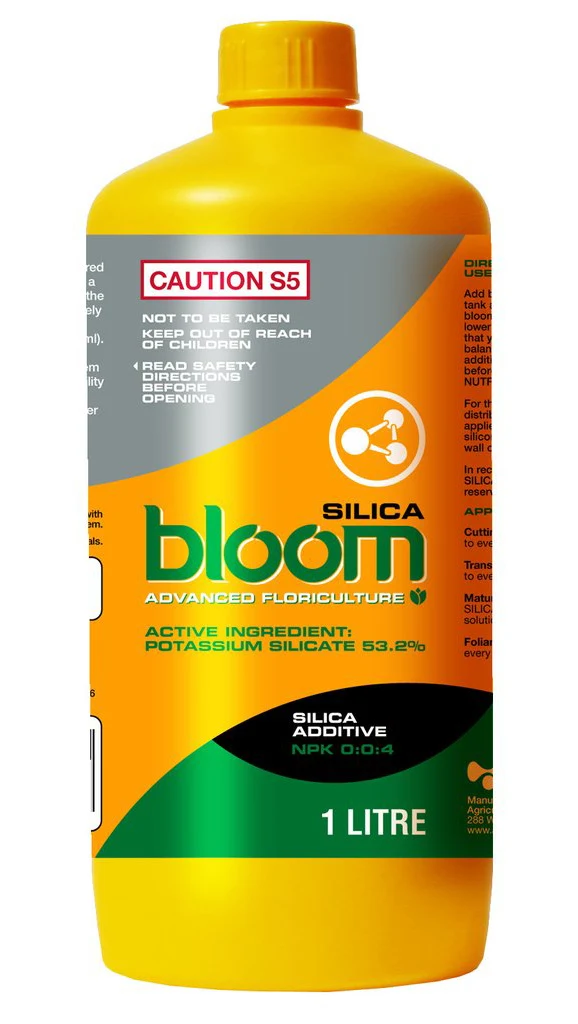
53.2% potassium silicate — the highest concentration available in a liquid silica additive.
Bloom Yellow Bottles Silica (AOSB-250) is a 250ml super-concentrated liquid potassium silicate at 53.2% — the highest concentration available on the market — delivering measurable structural and pest-resistance benefits across every growth stage. Compatible with all media types and feeding programs, it integrates directly into your existing nutrient line without requiring a reduction in base fertilizer rates.
Bloom Yellow Bottles Silica is a liquid potassium silicate additive formulated at 53.2% concentration — documented as the highest available in a market-ready liquid silica product. It is produced by Agricultural Organics, an Australian-founded company whose Advanced Floriculture system is built around highly concentrated, low-dose inputs designed to reduce per-liter cost at commercial scale.
At 53.2%, the active potassium silicate content is substantially higher than most competing silica supplements. Because potassium silicate cannot be translocated within the plant once deposited, consistent application throughout the crop cycle is how structural benefits accumulate — the high concentration means small volumes per feeding, which matters when you are running hundreds or thousands of liters per week.
The 250ml size (SKU: AOSB-250) is well-suited for operators running trial programs, smaller facilities, or those integrating Bloom Silica into an existing nutrient stack before committing to larger volumes. The same formulation ships in 1L, 5L, and 15L sizes.
Licensed cannabis and hemp cultivation operators running any production system — recirculating hydro (DWC, NFT, flood-and-drain), coco, soil, or run-to-waste — can slot Bloom Silica directly into their current feed program. No fertilizer reduction is required when adding it to an existing schedule, which simplifies adoption at facilities where feed programs are already dialed in.
IPM-focused operations benefit specifically from the structural protection silica provides: thicker cell walls make physical penetration harder for thrips, mites, and other chewing pests, and the same cell-wall fortification limits fungal colonization pathways. For facilities in high-humidity environments or those managing powdery mildew pressure, consistent silica supplementation functions as a preventive structural layer that complements chemical or biological IPM protocols.
Production teams running heavy-flowering cultivars — particularly those where branch breakage under load is a recurring issue — will see direct application in the structural benefit: stronger stems and branches better able to support dense flower mass late in the cycle.
Cell wall fortification is the primary mechanism. Silica is deposited in epidermal cells and the spaces between them, physically thickening the barrier layer. This reduces both mechanical pest damage and water loss through transpiration — a meaningful factor in maintaining plant turgor under high VPD or heat stress conditions.
Root zone function also improves with regular silica supplementation. Healthy root development supports more efficient nutrient uptake and CO2 assimilation, which reinforces overall canopy performance. The product also carries secondary utility as a pH-raising agent: because it is highly alkaline, it can be used to bring nutrient solution pH up when needed — a practical dual-use in facilities that manage pH manually.
Foliar application is supported for targeted fungal outbreak control. When applying as a foliar, standard precautions apply: Bloom Silica is highly alkaline and should be handled with gloves and eye protection. Pre-dilute in a bucket of pH-neutral water before adding to reservoir or spray tank to avoid precipitation or localized pH spikes.
Bloom Silica integrates at the additive layer of any nutrient program — it does not replace base nutrients and does not require reformulating your feed schedule. Add it first to a vessel of water, allow it to equilibrate to around pH 7, then combine with your nutrient solution. If you are using it to raise pH, add to the reservoir incrementally and stop when you reach your target — do not over-correct.
Run Bloom Silica from vegetative stage through the end of flower, then discontinue at least one week before harvest during the final flush. Because potassium silicate is not translocated, stopping early allows the plant to clear residual potassium without silica continuing to accumulate in tissues.
At commercial scale, the ultra-concentrated formula keeps per-liter additive cost low and storage footprint minimal. The 250ml trial size lets your cultivation team validate the product against your current silica source before scaling to 1L, 5L, or 15L formats — contact HSC for volume pricing and lead times.
| SKU | AOSB-250 |
| Brand | Bloom Yellow Bottles (Agricultural Organics) |
| Active Ingredient | Potassium silicate |
| Potassium Silicate Concentration | 53.2% |
| Volume | 250ml |
| Application Rate — Recirculating | 0.17 ml per liter of nutrient solution |
| Application Rate — Soil | 0.17 ml per liter of nutrient solution |
| Application Rate — Run to Waste | 0.33 ml per liter of nutrient solution |
| Use Stage | Vegetative through late flower; discontinue ≥1 week before harvest flush |
| Compatible Media | Hydro (recirculating & run-to-waste), coco, soil — all growing methods |
53.2% refers to the potassium silicate content by weight in the liquid formulation. Most competing liquid silica products on the US market are formulated significantly below this level. A higher concentration means you use less product per liter of nutrient solution — the published application rate is 0.17 ml/L for recirculating and soil systems — so a small bottle covers substantial reservoir volume.
No — do not add it directly to a full reservoir. Because it is highly alkaline, direct addition can cause localized pH spikes or precipitation. The correct method is to add Bloom Silica to a separate vessel of water first, allow it to reach approximately pH 7, then add that diluted solution to your reservoir or nutrient tank. If you are using it to raise nutrient solution pH, add incrementally and stop at your target pH.
No. Within the Bloom Yellow Bottles Advanced Floriculture system, fertilizer application rates do not need to be reduced when adding Bloom Silica. It is designed to stack with your existing base nutrient and additive program.
Discontinue at least one week before harvest while performing your final flush. Potassium silicate is not translocated once deposited in plant tissue, so stopping early allows the plant to process residual potassium from the nutrient solution without additional silica accumulation during the flush window.
Yes. Foliar application is supported — it is specifically noted as useful for managing active fungal outbreaks. When applying as a foliar, use appropriate PPE (gloves, eye protection) and pre-dilute thoroughly given the product's high alkalinity. Follow the feed schedule guidelines or develop a dilution rate suited to your system and application frequency.
Get operator-direct pricing and availability. We supply licensed commercial cultivators nationwide.
Request a Quote