
Cannabis trellis netting does more mechanical work per dollar than almost any other line item in a flower room. It redirects apical dominance, distributes bud weight across a structural plane, and eliminates the stem contact—and the resulting micro-wounds—that accumulate when crews hand-tie with raffia or twine. What it does not do is run itself: mesh size, material stiffness, layer count, install timing, and teardown protocol all materially affect whether the net earns its place or becomes a labor liability. This guide covers the decision criteria and the numbers, not the basics.
What Cannabis Trellis Netting Is Actually Doing Mechanically
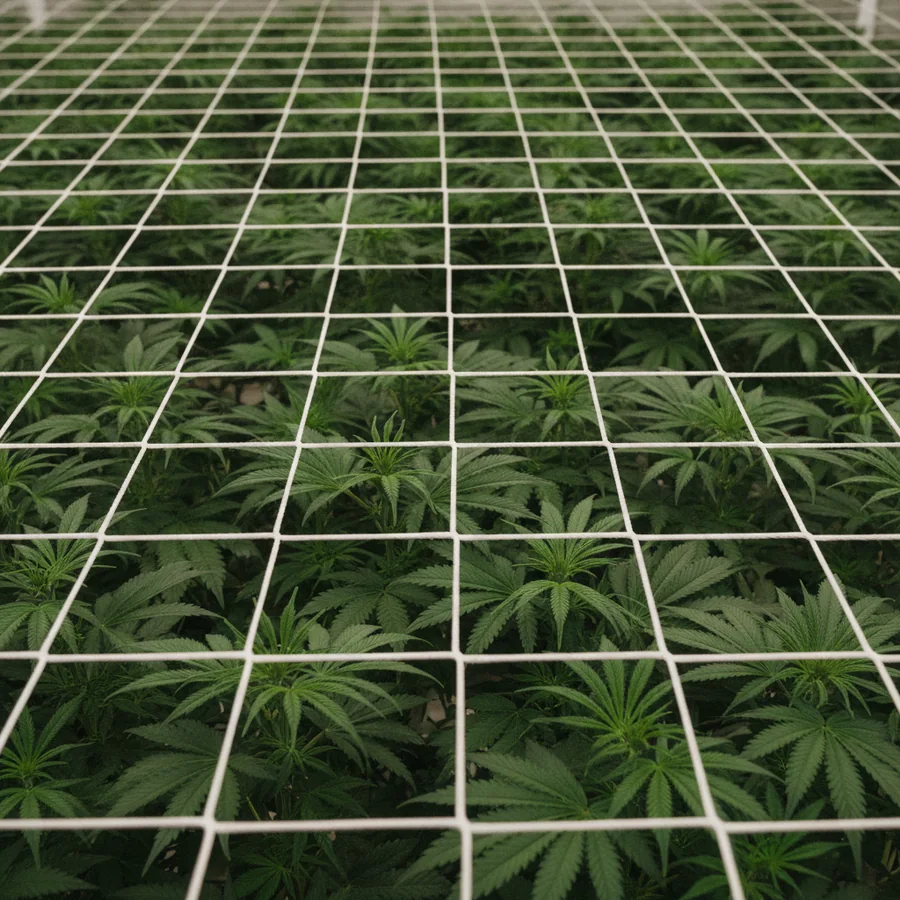
A horizontal SCROG net is not passive infrastructure. During vegetative growth, it functions as a training fixture: branches are tucked beneath the plane and redirected laterally, which suppresses the apical meristem's hormonal dominance and promotes auxin redistribution to every lateral shoot simultaneously. The result is a multi-cola plant with a flat canopy profile that fills the net's footprint rather than piling vertical mass under a single main cola.
Once the canopy enters flower and stretch concludes, the net transitions from a training tool into a load-bearing structure. Dense indica-leaning cultivars can push individual cola weights of 30–60 grams or more per branch by week seven or eight of flower. Without a structural plane to rest against, branches either collapse at the junction with the main stem or require individual staking — both outcomes that increase touch events per plant and create stem wounds that serve as pathogen entry points. The net distributes that load across dozens of grid intersections simultaneously, which is a fundamentally different engineering approach than tying each stem individually.
There is a parallel airflow benefit. By holding lateral branches in a defined horizontal plane, the net creates consistent spacing across the canopy surface, which supports uniform vapor pressure deficit management at the leaf level. Unmanaged canopies develop pockets of stagnant humid air wherever branches overlap — the precondition for botrytis and powdery mildew at late flower.
Material and Mesh Size: Choosing the Right Cannabis Trellis Netting
Two material categories cover the vast majority of commercial applications: extruded polypropylene (rigid, dimensionally stable grid) and soft polyester mesh (flexible, lower abrasion risk). The choice is not about brand preference — it is about what role the net is playing.
Extruded polypropylene holds its cell geometry under load. The grid does not deform when branches push against it, which is what makes it effective as a training surface during veg. The rigidity also makes tensioning easier — you can pull the net drum-tight between anchor points and it stays flat. The trade-off is that rigid PP is harder on stems than soft mesh if branches move laterally within cells during stretch; cultivars with vigorous internodal expansion should be monitored during the first two weeks of flower.
Soft polyester SCROG mesh conforms slightly to stem contact, which reduces abrasion on cultivars that push hard against cell walls during stretch. It is the preferred format for support-layer applications — where the net is not training branches but simply catching them — and for rooms running high plant density where stems may contact the net at multiple points per cell.
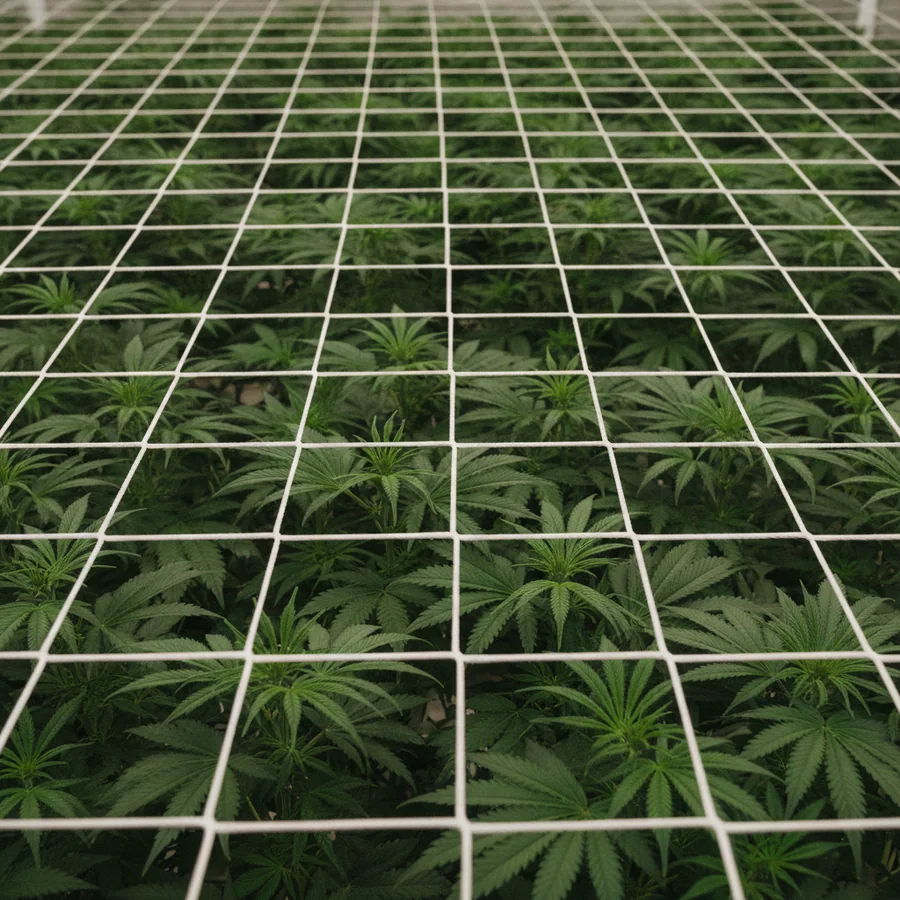
On mesh cell size: 6-inch squares are the commercial standard for cannabis. Cells smaller than 4–5 inches make canopy access difficult — tucking and inspection require reaching through cells, and tighter spacing multiplies the points of stem contact during teardown. Cells larger than 7–8 inches reduce the number of support points per linear foot, which allows branching to flop laterally under its own weight at peak flower. The 5.9 in × 6.7 in geometry on HSC's polypropylene rolls and the 6 in × 6 in geometry on the polyester SCROG mesh both fall in the commercial sweet spot: large enough to work both sides of an aisle furrow without damaging the crop, small enough to hold structure through late flower.
Single vs. Double Layer: Timing, Height, and When Each Earns Its Place
Most commercial rooms operate with two net layers. Understanding what each one is doing prevents both under-investment (one net trying to do two different mechanical jobs) and over-investment (three nets on cultivars that don't need the third).
Installing Layer 1 too early restricts growth before the plant has adequate lateral branching to fill the net. Installing it too late means branches are already woody and won't bend through cells without snapping. The window is late veg when branches are still actively elongating and flexible. Target 70–80% net fill before flipping to 12/12 — underfilled nets produce uneven canopies; overfilled nets create airflow problems from day one of flower.
Layer 2 is a support layer, not a training layer. Once branches have set their direction, there is no point trying to retrain them through a second net. Install it 6–8 inches above the first — at this height it intercepts bending branches before they break at the internode, which is the failure mode that causes yield loss in weeks six through eight of flower on heavy-producing phenotypes.
Horizontal SCROG vs. Vertical Tutoring: When Each Format Applies
Horizontal SCROG is the standard indoor canopy management format. The net runs parallel to the grow surface and perpendicular to the light plane. Every bud site is trained to a uniform distance below the fixture, which is the mechanical prerequisite for the light homogeneity that high-output fixtures are designed to deliver. For most commercial indoor and indoor-greenhouse hybrid facilities, this is the correct default.
Vertical tutoring — running net panels vertically between rows rather than horizontally above beds — is the dominant format in outdoor and greenhouse row production where plant heights exceed 5–6 feet and lateral management at scale becomes impractical. Vertical netting supports the plant from the sides rather than from above, which is appropriate for tall cultivars that cannot be trained flat without excessive defoliation.
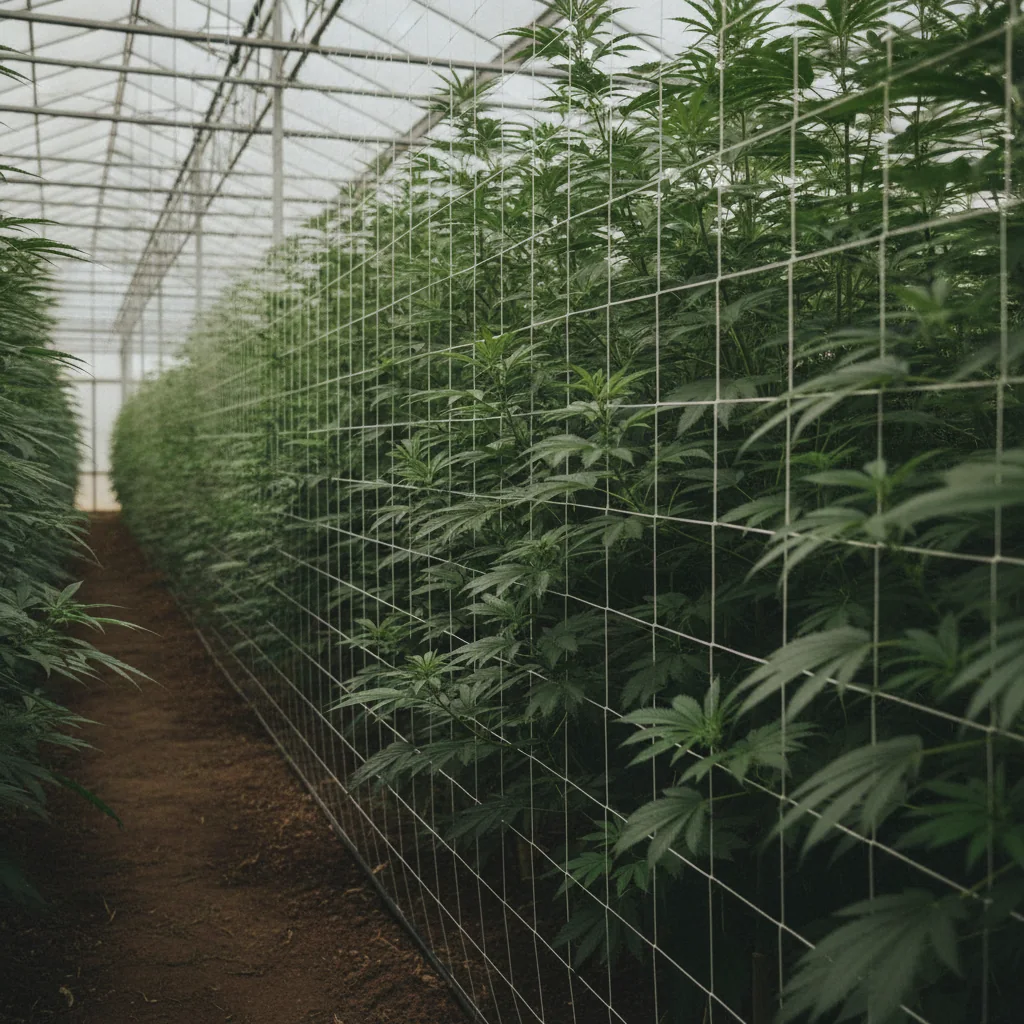
The practical decision for a commercial indoor operator is almost always horizontal SCROG. The exception is multi-tier vertical racking, where the grow geometry does not allow a traditional horizontal net above each tier without compromising access. In tiered systems, a combination of horizontal support nets per tier and vertical side-panel netting for aisle-facing branches is the solution most operations converge on.
For the canopy-management category including netting and supporting cultivation equipment, the format decision drives everything downstream: roll width selection, linear footage per bay, tensioning hardware, and teardown protocol.
Roll Sizing: Matching Net Width to Bed and Bay Dimensions
Roll selection starts with bed width and ends with per-cycle linear footage. Getting this wrong creates one of two problems: a net that does not reach the anchor points on the short axis (requiring seaming, which creates weak points and airflow disruption) or a net that overhangs significantly and must be trimmed, which wastes material and adds labor.
HSC's polypropylene rolls are available in 4 ft, 5 ft, and 6.5 ft widths on 4,920 ft rolls with a 5.9 in × 6.7 in mesh. The polyester SCROG mesh comes in 5 ft and 6.5 ft widths on 350 ft rolls with a 6 in × 6 in mesh. The 5 ft width is sized for a standard 4-foot-wide bed or table with a 6-inch overhang on each side for anchor attachment. The 6.5 ft width covers 5-foot-wide beds or wider multi-plant floor beds. The 4 ft polypropylene is suited to single-table or narrow-aisle rack systems where working clearance is tight.
To calculate linear footage per room: multiply bed length (in feet) by the number of beds requiring coverage, then add 10–15% for tensioning overrun, anchor loops, and any mid-bay intermediate supports. For a room with twelve 4×16 ft beds running two layers: 12 beds × 16 ft × 2 layers = 384 linear feet of net per cycle. On a 350 ft polyester roll that is slightly more than one roll per cycle per room — plan for a minimum order quantity of 5 rolls to cover multiple rooms or multiple cycles without restocking friction.
The Labor Argument: Netting vs. Raffia and Hand-Tying
The economic case for trellis netting over hand-tying is not primarily about material cost. It is about touch events per plant across a full cycle. Hand-tying with raffia or twine typically requires 5–10 minutes of labor per plant at installation, followed by two to three rounds of adjustment as bud mass accumulates and tied stems shift. On large-producing phenos, that means retying at least 50 percent of tied branches at least once during flower — additional minutes per plant, multiplied across the room, at commercial labor rates.
A horizontal net eliminates individual tie events entirely. Once installed and tensioned, the net passively manages branching as plants grow through it. The only recurring touch event is the weekly canopy walk to tuck new lateral growth — a task that takes seconds per cell rather than minutes per stem. Across a 10-week flower cycle in a room of 500 plants, the difference in direct labor hours is significant, and the reduction in stem micro-wounds directly reduces pathogen pressure.
The trade-off is teardown. A net loaded with 8–10 weeks of mature cannabis growth — with resinous stems woven through every cell — is not quick to remove. Stripping spent growth out of a polypropylene net at the end of a run can take as long or longer than the initial installation, particularly when buds have swollen past cell openings and stems have stiffened into position. Some high-cycle commercial rooms correctly treat netting as a single-use consumable and budget the roll footage accordingly — cut and clear at harvest, fresh net next run. Others cut at the stem line, leaving plant material in the net for trim crew to process separately, then clean and re-tension. The right call depends on your cycle velocity, labor structure, and IPM requirements.
Facilities operating under strict integrated pest management protocols may opt for single-use netting specifically to eliminate cross-cycle contamination risk. On bulk rolls — 4,920 linear feet per polypropylene roll — the per-cycle material cost of treating the net as consumable is low enough to be a straightforward line item. For these operations, the UV-stabilized extruded polypropylene range provides the most cost-effective path: rated for 5–7 years of UV exposure, which in an indoor facility means the structural integrity is not the constraint — labor economics at teardown is.
Installation, Tensioning, and Cycle-End Protocol
Installation sequence for a two-layer system:
- Set uprights or attach to existing frame rails at the correct height for Layer 1 (8–12 inches above container tops for a SCROG training net).
- Unroll the net along one long axis of the bed, secure the far short edge first with S-hooks or cable ties — not zip ties, which are single-use and add teardown time.
- Pull the net across the bed toward you, tensioning along the long axis before securing the near short edge. The grid should be taut enough that pressing a palm to the center deflects less than 1 inch.
- Work along both long edges, pulling and securing every 18–24 inches. Mid-bay intermediate supports (cross-bar or vertical post) are required for spans longer than 8 feet to prevent mid-span sag as plant mass accumulates.
- Begin tucking branches at least 4–6 weeks before the target flip date, aiming for 70–80% cell coverage at flip.
- At flip or week 1–2 of flower, install Layer 2 at 6–8 inches above Layer 1. No tucking on this layer — its only job is structural support.
- Inspect tension weekly. Nets under load from developing colas can sag at midspan; re-tension intermediate support points as needed in weeks 4–7 of flower.
Teardown protocol — reuse path: After harvest, cut plants at the base and allow stems to dry in the net for 24–48 hours before removal. Dried stems release from polypropylene cells more cleanly than fresh ones. Remove plant material by unthreading (not cutting) wherever possible. Rinse nets with water, inspect for broken strands or deformed cells, store rolled in a clean dry space. Nets rated for 5–7 years of UV exposure will not degrade structurally in indoor conditions within that window, but physical damage from repeated forced extraction is the real limiting factor on service life.
Teardown protocol — consumable path: Cut nets at the anchor perimeter at the end of the run, roll the entire net and plant material together for biomass disposal, and install fresh net on the cleaned frame before the next run begins. On short-cycle operations (8-week flower, rapid room turns), this approach eliminates the teardown labor variable entirely and removes any IPM cross-contamination risk from net reuse. The 4,920 ft polypropylene roll format is specifically suited to this model.
Cleaning and Retiring Nets Between Cycles
If nets are designated for reuse, the cleaning protocol matters for IPM integrity. Polypropylene is chemically resistant — it tolerates isopropyl alcohol, dilute bleach (sodium hypochlorite at 200–500 ppm), and hydrogen peroxide washes without structural degradation. The mechanical challenge is getting cleaning solution into contact with all surfaces, including the inside faces of grid nodes where resin and plant debris accumulate.
Soak and agitate (pressure wash or pump sprayer) produces better surface contact than a simple rinse. Allow nets to dry fully — damp stored nets develop mold on organic debris trapped in the weave, which defeats the purpose of cleaning. Inspect for broken strands at node points before storage; a net with compromised structural nodes will fail mid-cycle under bud weight, which is a much worse outcome than retiring it proactively.
The retirement decision is straightforward: if a net has broken nodes at more than 5% of its grid intersections, or if it cannot be tensioned flat without mid-span deflection exceeding 2 inches, retire it. On bulk rolls, the per-run material cost is low enough that running a compromised net to save material cost is a poor trade.
Frequently asked questions
What mesh cell size is correct for commercial cannabis SCROG?
When exactly should I install the first trellis layer relative to the flip?
Is a second trellis layer always necessary?
Should commercial rooms treat trellis netting as reusable or consumable?
What is the minimum order quantity and what roll formats are available for commercial planning?
Planning a build or an upgrade?
Hydro Supply Co. supplies commercial cultivators nationwide — lighting, climate, irrigation, nutrients and post-harvest, from one source.
Request a Quote